Beyond the Hype: 6 Impactful Realities of Pursuing an AI Master's in 2025/2026
A guide for software engineers looking to pivot, graduate students choosing their specialisation, and career-changers seeking to capitalize on the most significant technology wave of the decade.
Listen
Watch
The artificial intelligence industry in 2025 is a landscape of deafening noise and unprecedented velocity. For the ambitious professional, the central question has shifted from "Is AI real?" to "Is a Master's degree the right vehicle for my career?" With the professional "half-life" of technical skills now shrinking to a mere 2.5 years, the cost of a wrong move is higher than ever.
As a career strategist, I view a Master's degree not as a simple academic milestone, but as a strategic asset. This post distills the most critical data from the 2025/2026 job market and admissions guides to help you determine if this investment will yield the ROI you require.
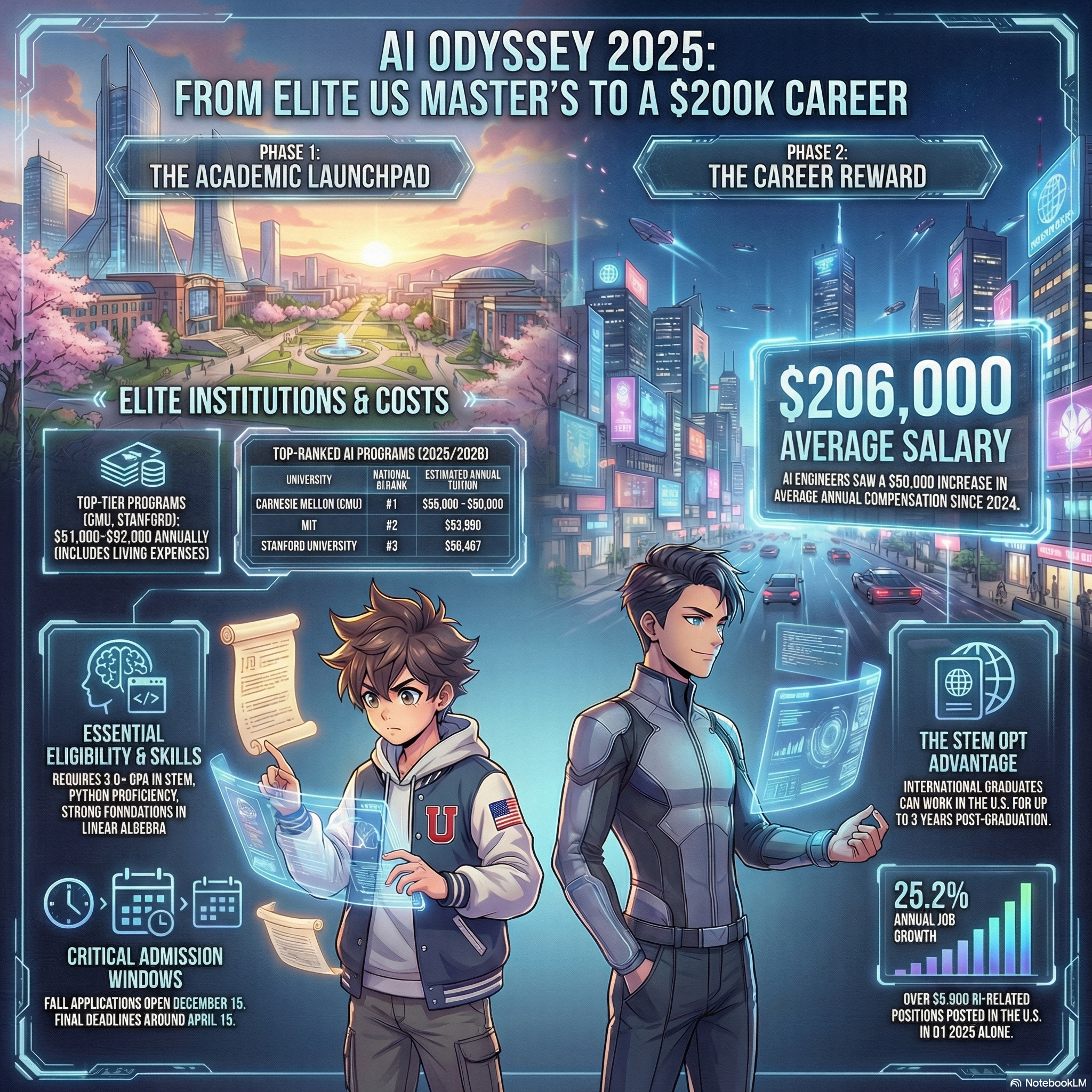
1. The $206,000 Average: The New Baseline for AI Engineers
The financial incentives for specialized AI expertise have moved past "competitive" into a tier of their own. According to the latest job market data, the "wage premium" for AI-capable workers is now 35% higher than their non-AI counterparts. However, simply having "AI" on your resume isn't enough to hit the top of the bracket.
"AI engineers are now averaging $206,000 annually—a massive $50,000 increase from the previous year—while the median salary for all AI roles has risen to $156,998."
To exploit this reality, you must focus your graduate studies on system architecture and model optimization. Employers are moving away from hiring generalists who simply call APIs; they are paying a premium for those who can build and deploy complex infrastructure. If you want to command that $206k baseline, your Master's must provide deep-level competency in how these models are fundamentally constructed.
2. The "Elite for Less" Hack: Top-Tier Degrees Under $10,000
The old guard of tech education—the $60,000 to $90,000 price tags at private institutions—is being disrupted by elite public programs. For a career strategist, this represents the ultimate "ROI multiplier." You can now secure a top-tier brand name on your resume while removing the debt-burden barrier to entry.
The undisputed leaders here are the Georgia Institute of Technology's OMSCS program ($7,000) and the University of Texas at Austin's Artificial Intelligence - Option III ($10,000). Both programs are fully online and asynchronous, meaning you can maintain your current income while scaling your credentials. These are not "lite" versions of the degrees; they offer the exact same curriculum and diploma as on-campus programs, allowing you to arbitrage the prestige of a top-10 university for the price of a local bootcamp.
3. The 20% to 40% "Master's Ceiling"
In the "Move Fast and Break Things" era, portfolios were king. In the "Generative AI" era, the degree is becoming the primary gating mechanism. While a Bachelor's degree can still get you through the door at a well-funded startup, the most prestigious R&D labs—including OpenAI, Google DeepMind, and Anthropic—overwhelmingly require graduate degrees for their core research and leadership roles.
The data supports this "credentialing" of the industry:
- 79% of AI job postings now explicitly prefer graduate-level candidates.
- Master's-level professionals earn a 20% to 40% premium over Bachelor's holders in equivalent roles.
Think of the Master's as your ticket to the "Staff" and "Principal" levels. It isn't just a piece of paper; it is a signal to elite recruiters that you possess the theoretical depth to navigate the edge of what is currently possible.
4. Math is the Engine, Not Just Coding
A dangerous misconception is that AI is a "Python-first" field. In reality, coding is the skin, but mathematics is the skeleton. A high-end Master's program provides the "mental endurance" required for high-stakes problem solving by focusing on the mechanics behind the models.
"Math is more than a supporting tool for artificial intelligence (AI)—it's the engine that powers everything from data analysis to machine learning."
To survive a 2026 curriculum, you must master five core areas:
- Linear Algebra: Crucial for Principal Component Analysis (PCA) and reducing data complexity.
- Calculus: The foundation for gradient descent, the process that guides models toward the "right answer."
- Graph Theory: Essential for navigating social networks and fraud detection systems.
- Optimization: The branch of math that helps models work smarter with fewer resources.
- Probability & Statistics: Necessary for managing the inherent uncertainty in AI predictions.
5. Beyond Silicon Valley: Geography and Salary Arbitrage
While California remains the epicenter for AI startups, the rise of specialized tech hubs offers a unique opportunity for geographic salary arbitrage. Seattle (Amazon/Microsoft), Austin (General Tech), and Boston (Healthcare AI) have emerged as powerhouses for graduate talent.
The most successful strategists are using remote work to their advantage. While 65% of AI companies now offer distributed options, most come with a 10% to 15% salary normalization. The play here is clear: leverage your Master's to secure a San Francisco-based salary while living in a hub like Austin or Seattle, where your $206,000 baseline stretches significantly further.
6. The 12-Month Transition: A Realistic Pivot Timeline
The "entry-level challenge" in AI is daunting: currently, only 2.5% of AI positions target candidates with 0–2 years of experience. For career switchers, this means you cannot simply "dabble." You need a structured, 12-month project-based plan to bridge the gap.
If you are coming from a non-technical background, certain programs like UCLA's MEng in AI (a 1-year accelerated path) or the University of San Diego's MS in Applied AI are specifically designed to help career switchers transition quickly.
"54% of employees will need significant reskilling by 2025... professional skills half-life [is] shrinking from 5 years to 2.5 years."
Your transition should follow a phased approach:
- Months 1-3: Foundation (Python, Linear Algebra).
- Months 4-6: Core ML (Supervised/Unsupervised Learning).
- Months 7-9: Advanced Skills (Deep Learning/Cloud Deployment).
- Months 10-12: Portfolio and Certification (Building 3-5 demonstrable projects).
Conclusion
The AI revolution is not a distant wave; it is a current that is already moving the market. In an environment where the skills you learn today may expire in 30 months, the "wage premium" belongs to those who anchor their careers in the fundamental science of the field.
As you look toward the 2025/2026 cycle, I challenge you to consider this: In a market that is aggressively automating routine work, are you building a career that is AI-enhanced, or one that is AI-replaceable? The gap is widening, and the most significant risk you can take is standing still.