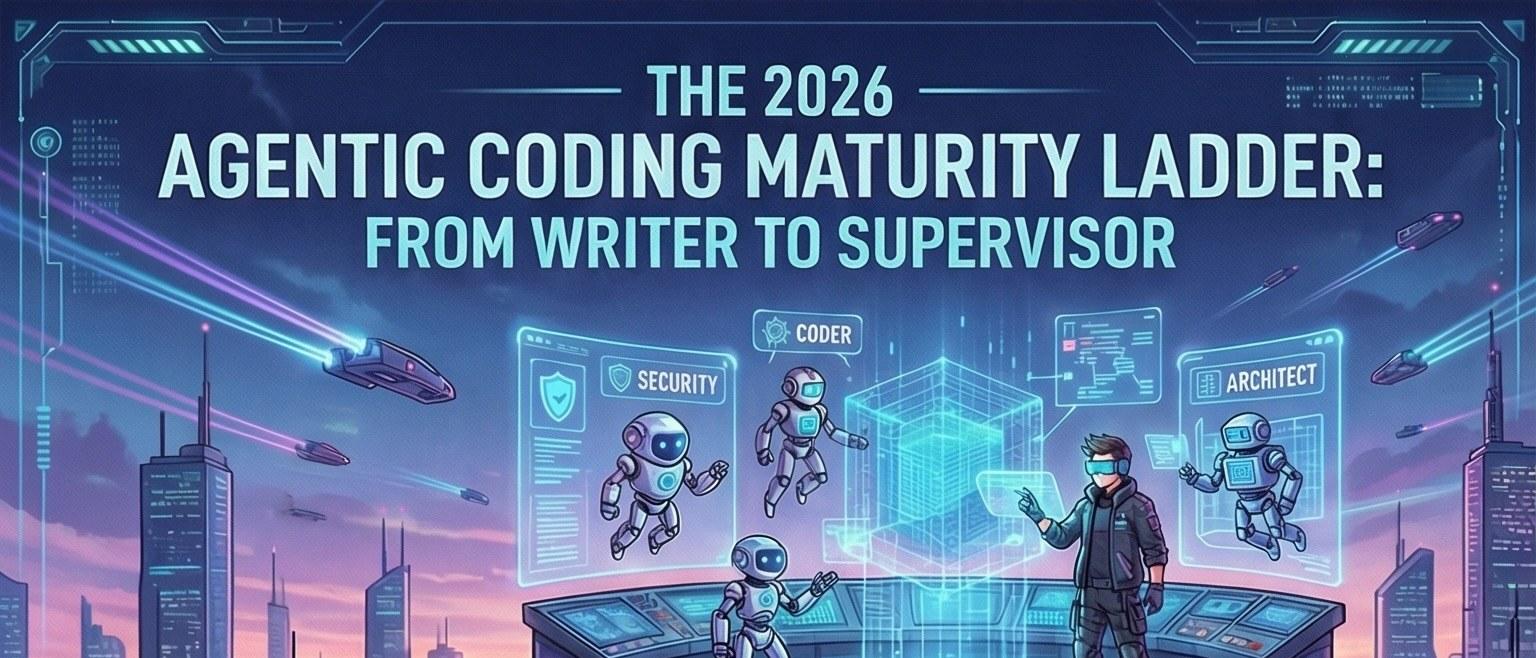
Beyond the Vibe: Mastering the 2026 Agentic Coding Maturity Ladder
A five-stage framework defining how developers evolve from AI chat users to orchestrators of multi-agent software ecosystems.
Listen
Beyond the Vibe: Mastering the 2026 Agentic Coding Maturity Ladder
The software development landscape in 2026 has crossed a definitive threshold, transitioning from experimental AI companions to a structural layer where 92% of US developers use AI tools daily. We have moved from simple code completion to full-scale delegation, where the most valuable engineers are no longer the fastest typists, but the best orchestrators of intelligent systems. To navigate this shift, developers must climb the Agentic Coding Maturity Ladder, a five-stage framework defining how humans and AI agents co-construct software.
The Five Rungs of Maturity
Mastering this ladder is essential because the skills are compounding; you cannot effectively leverage higher-level autonomous capabilities without first understanding base-level AI interaction.
- Chat: The entry point where developers use conversational interfaces like ChatGPT or Claude to copy-paste code or develop requirements. Success here requires mastery of context engineering—knowing exactly what to feed into (and exclude from) the context window to get consistent results.
- Midloop Generation: AI meets the developer within the IDE as "autocomplete on steroids". At this stage, developers must critically evaluate multiple alternative implementations suggested by the AI based on code comments to select the best design path.
- In-the-Loop Agentic Coding: Often called the "babysitting" phase, developers work closely with agents, observing their struggles and "doom loops". This stage is vital for learning how to install guardrails and build a library of reusable meta-prompts and hooks.
- On-the-Loop Agentic Coding: The developer hands off a "package of work" and steps away, returning only to verify high-quality finished artifacts. Mastery is reached when you can manage multiple parallel agent sessions effectively.
- Multi-Agent Coding: The highest rung involves managing a "fleet" or "team" of specialized agents—such as dedicated Architect, Coder, Test, and Security agents—that coordinate autonomously to deliver complex systems.
Reliability through the Ralph Wiggum Loop
A cornerstone of moving up the autonomy slider is the Ralph Wiggum loop. This architecture wraps a while loop around a coding agent with a deterministic halting condition. Instead of trusting an agent that claims "all tests pass," the loop runs hard checks, such as verifying if the code compiles or if the test suite actually executes. If the checks fail, the system forces the agent to start a new session and iterate until the work is truly completed. This approach demonstrates that achieving autonomy does not require Artificial General Intelligence (AGI); it simply requires persistence.
The Shifting Skillset: Fading vs. Evergreen
As orchestration becomes the standard, traditional developer skills are bifurcating:
- Fading Skills: Manual syntax knowledge and writing routine boilerplate code in established codebases are becoming irrelevant for senior engineers.
- Evergreen Skills: System architecture, problem decomposition (often called "elephant carpaccio"), and a refined sense of judgment to validate AI outputs remain paramount.
- New Skills: Developers must now be proficient in harness engineering, managing Model Context Protocol (MCP) servers, and debugging complex agentic workflows.
Professionalization is also arriving through credentials like the NVIDIA-Certified Professional – Agentic AI (NCP-AAI), which validates a candidate's ability to architect multi-agent interactions and enforce ethical safeguards.
A Reality Check on Governance
While agents increase task correctness by 35% and reduce user effort by 50%, they bring significant risks. Studies show 45% of AI-generated code contains security vulnerabilities. This has led to the rise of "bounded autonomy", a framework that gives agents clear operational limits and mandatory escalation paths to humans for high-stakes decisions. Furthermore, the "accountability gap" remains a legal challenge, as it becomes harder to trace potentially harmful outputs back to a specific human instruction as systems take more independent steps.
In 2026, the goal is no longer just to write code, but to architect ecosystems of collaborative agents that operate with transparency, guardrails, and continuous improvement. Those who master the ladder will find themselves empowered to lead the next generation of software engineering.